Lanterns in Morocco: names, meaning and where to buy them
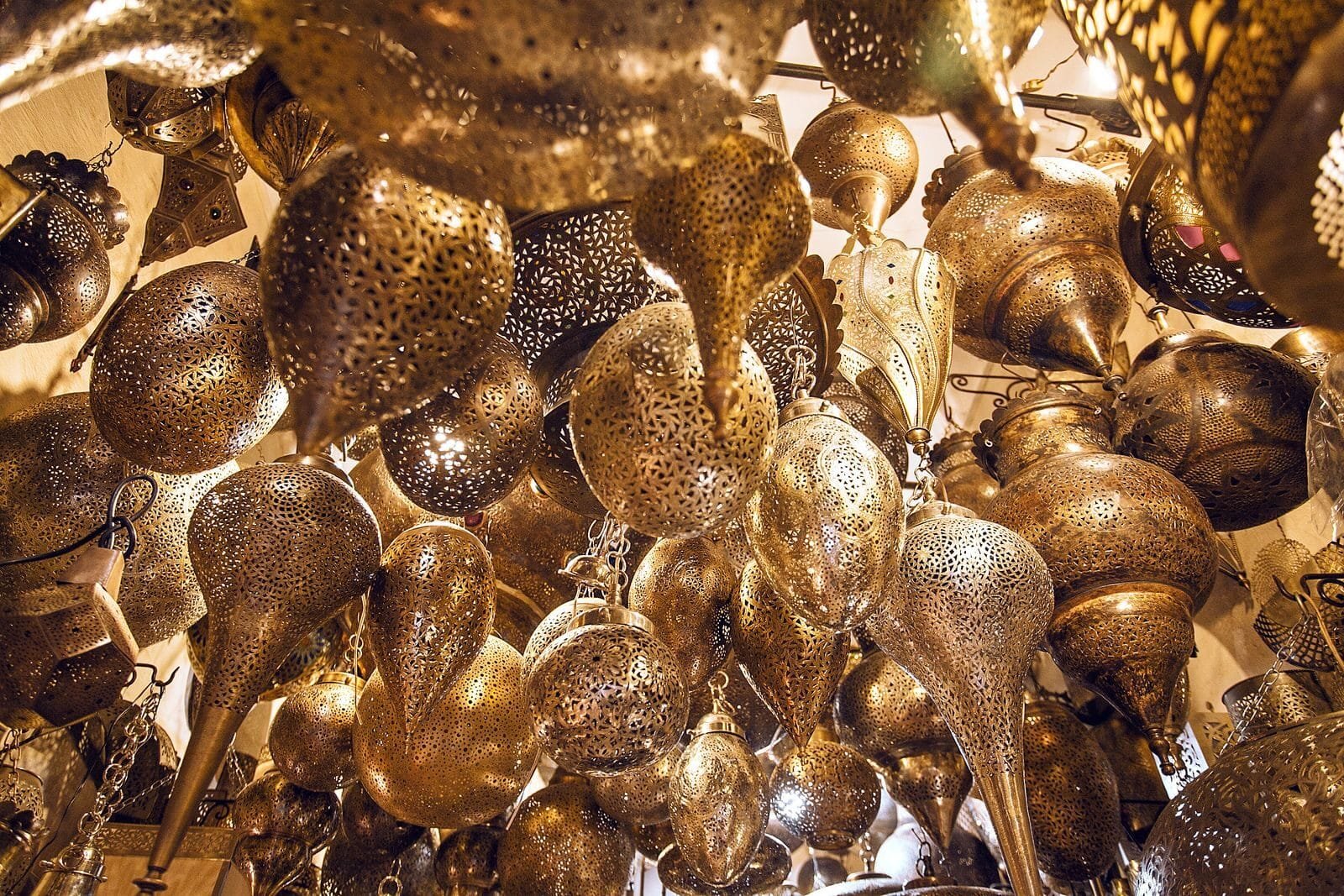
Walk into any brass workshop in the Marrakech medina at 4 pm and you will hear it before you see it. A steady tap tap tap of small hammers on sheet metal, followed by the softer scrape of a chisel cutting through brass. Move closer and you find a Maâlem, a master craftsman, punching a geometric pattern into a lantern that will hang in someone’s living room ten thousand kilometers away by Christmas.
The lanterns in Morocco are not really decor. They are an 800 year old craft, a spiritual object during Ramadan, and one of the few things you can bring home from a trip that keeps working after you unpack it. They are also cheaper here than anywhere else in the world, if you know which souk to walk into.
This guide covers what Moroccan lanterns are called, where they come from, how they are made, how much you should expect to pay, how to spot a real one, and how to use it once it hangs above your dining table at home.
Quick takeaways
- Moroccan lanterns are called fanous (fanoos) in Arabic. Plural is fawanees. Some Berber regions use different local names.
- They are made by hand. A single lantern can take a Maâlem 8 to 40 hours to cut, depending on the pattern.
- Brass and copper are the standard materials. Some also use wrought iron, tin, or camel bone inlay.
- The Marrakech medina and Fes have the most workshops. Buy at the source, not at the airport.
- Prices run from 150 dirhams to over 5,000 dirhams. That is roughly 15 to 500 US dollars, depending on size, material, and craftsmanship.
- Ramadan lanterns have a separate meaning. During the holy month, fawanees decorate streets, homes, and mosques as a symbol of hope and light.
- They pack better than you think. Most brass lanterns fold flat or nest inside each other for shipping.
What are Moroccan lanterns called?
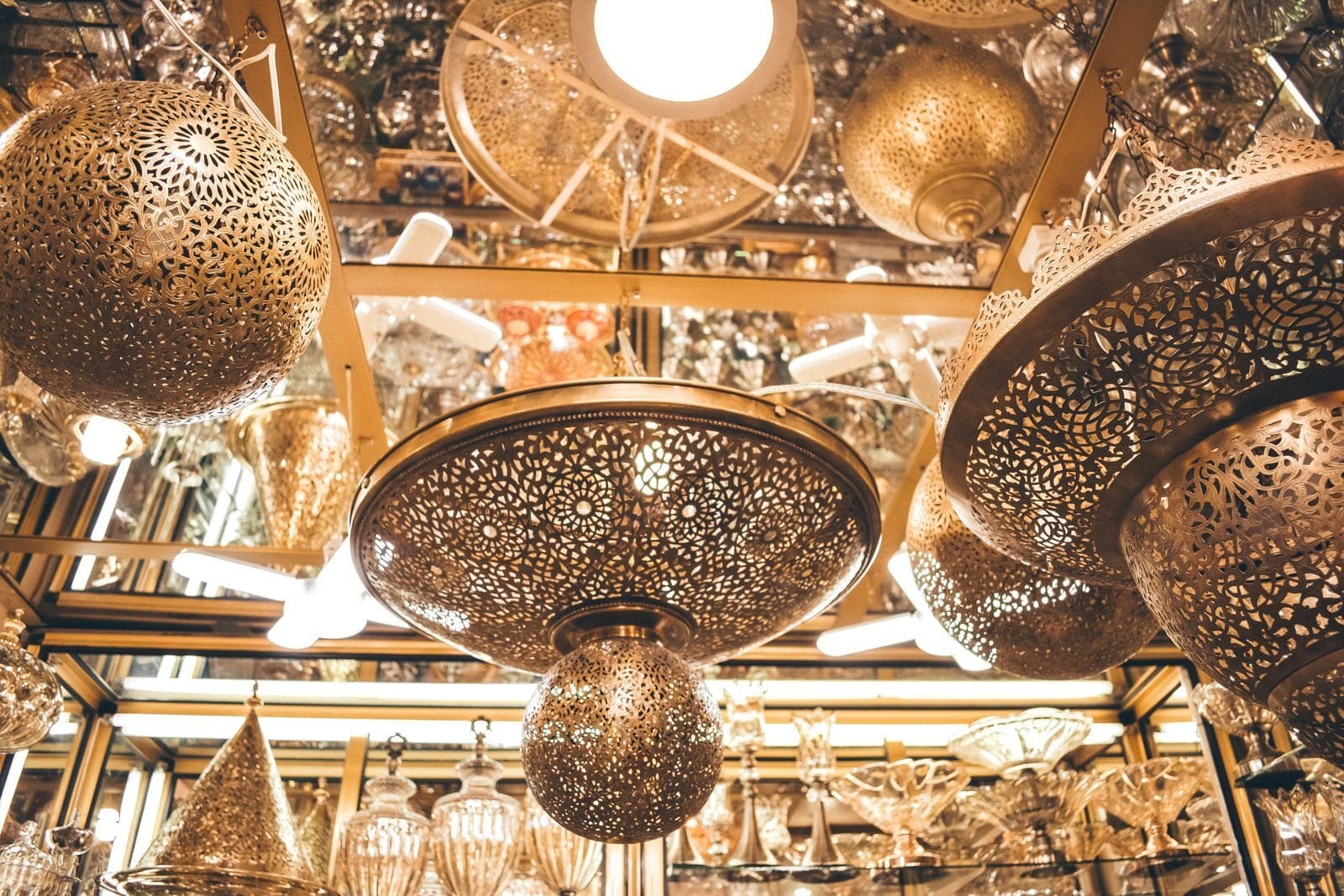
Moroccan lanterns are called fanous (fanoos) in Arabic, with fawanees as the plural form. The word itself comes from the Greek phanos, meaning a portable source of light, and has been part of the Arabic language since the Fatimid era in the 10th century.
Locally, Moroccans and shopkeepers use several related terms. In Berber areas, some artisans call them izzimr or leklit depending on the region. Most sellers switch to French or English with tourists and simply say lantern or lanterne. The name fanous still shows up on price tags, in workshop signs, and in casual conversation, especially in Fes and Marrakech.
Beyond the general name, specific shapes and functions have their own labels. A large hanging lantern designed for a ceiling is often called a mishkat, which comes from a Quranic verse about a niche holding a light. Table lanterns are sometimes called qandil. Wall sconces are labeled applique or menara. If you walk into a workshop and ask for a fanous, the artisan will usually ask which shape you have in mind before pulling anything off the shelf.
The word fanous is used across the Arab world for Ramadan lanterns, but Moroccan versions differ from Egyptian ones. Egyptian fawanees are often smaller, made from tin and colored glass, and designed to be carried by children in the street during Ramadan. Moroccan ones are usually larger, made from thicker brass or copper, and built for permanent installation in homes and courtyards.
Practical takeaways:
- Ask for a “fanous” in workshops for Moroccan name recognition
- Use “mishkat” for large ceiling lanterns
- Say “qandil” for smaller table pieces
- Bargain in dirhams, not euros or dollars
- Ship large pieces directly from the workshop rather than carrying them home
For families interested in seeing lanterns being made, Morocco Vacation Planner organizes private visits to real workshops in Fes and Marrakech where kids can watch a Maâlem at work.
A short history of Moroccan lanterns
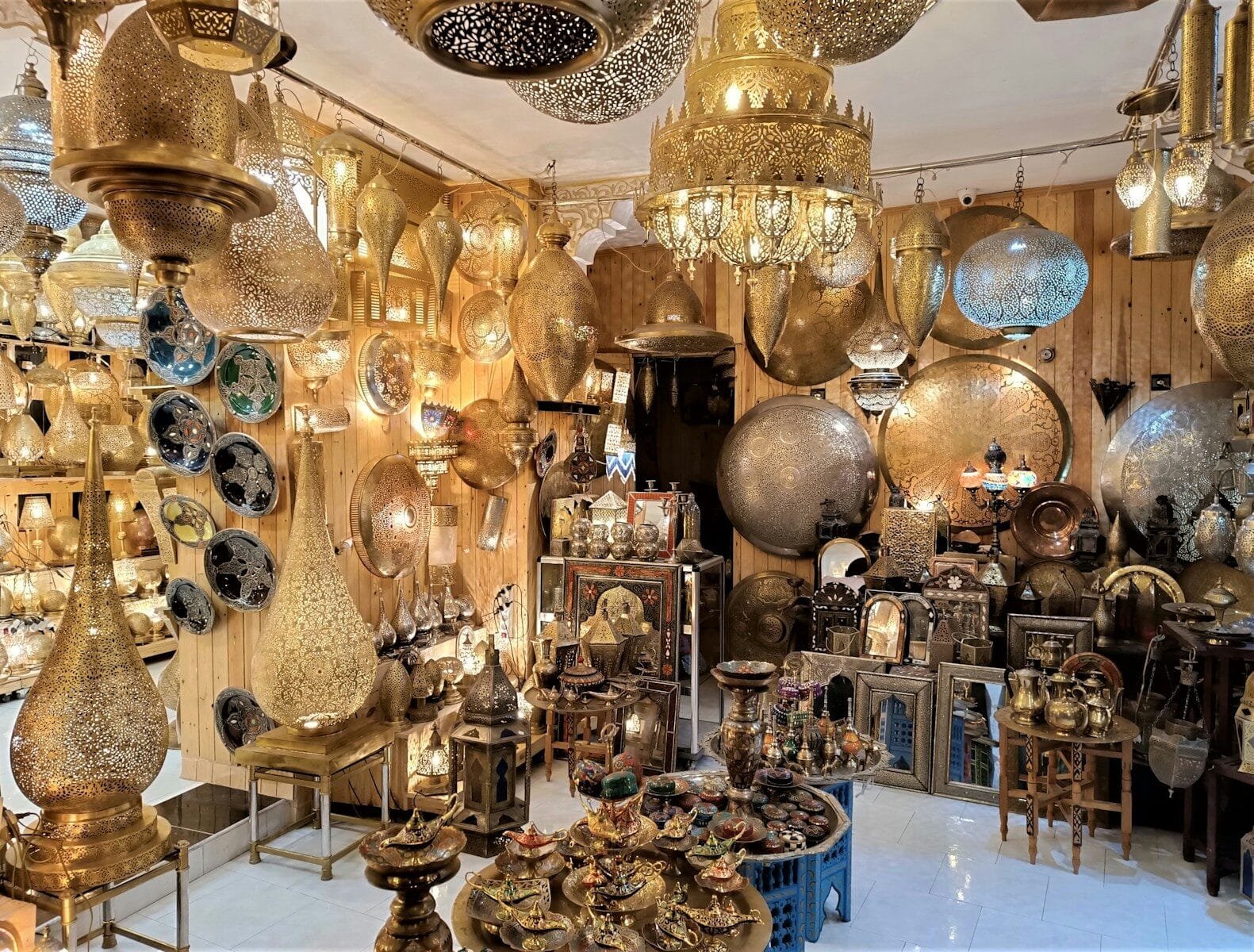
The tradition of hand crafting fanous in Morocco goes back to the Islamic Golden Age, roughly the 8th to 13th centuries. Andalusian craftsmen fleeing the reconquest of Spain brought their metalworking skills to Moroccan cities like Fes and Marrakech. Berber craftsmen already had a strong tradition of jewelry making and metal engraving. The two traditions merged and produced what you see today.
Islamic geometry sits at the core of the design. Because Islamic art traditionally avoids figurative representation, artisans developed patterns based on eight pointed stars, interlocking polygons, and floral arabesques. When light passes through those cutouts, the pattern projects onto the surrounding walls and ceilings. That projected shadow is the whole point. A good lantern is not judged only by how it looks when you hold it, but by what it does to the room.
Fes has the oldest continuous lantern making tradition in Morocco. The medina of Fes el Bali contains workshops that have passed from father to son for six or seven generations. Fassi lanterns tend to be heavier, more ornate, and often unglazed, meaning they rely entirely on the precision of the metal cuts to shape the light.
Marrakech followed later, becoming a major production center in the 16th century when the Saadian dynasty made the city its capital. The Marrakech style tends toward larger, more theatrical pieces with colored glass panels in amber, deep red, and cobalt blue. If you have seen photos of a Marrakech riad glowing at night, the lanterns responsible for that atmosphere are almost always Marrakech style.
How Moroccan lanterns are made?
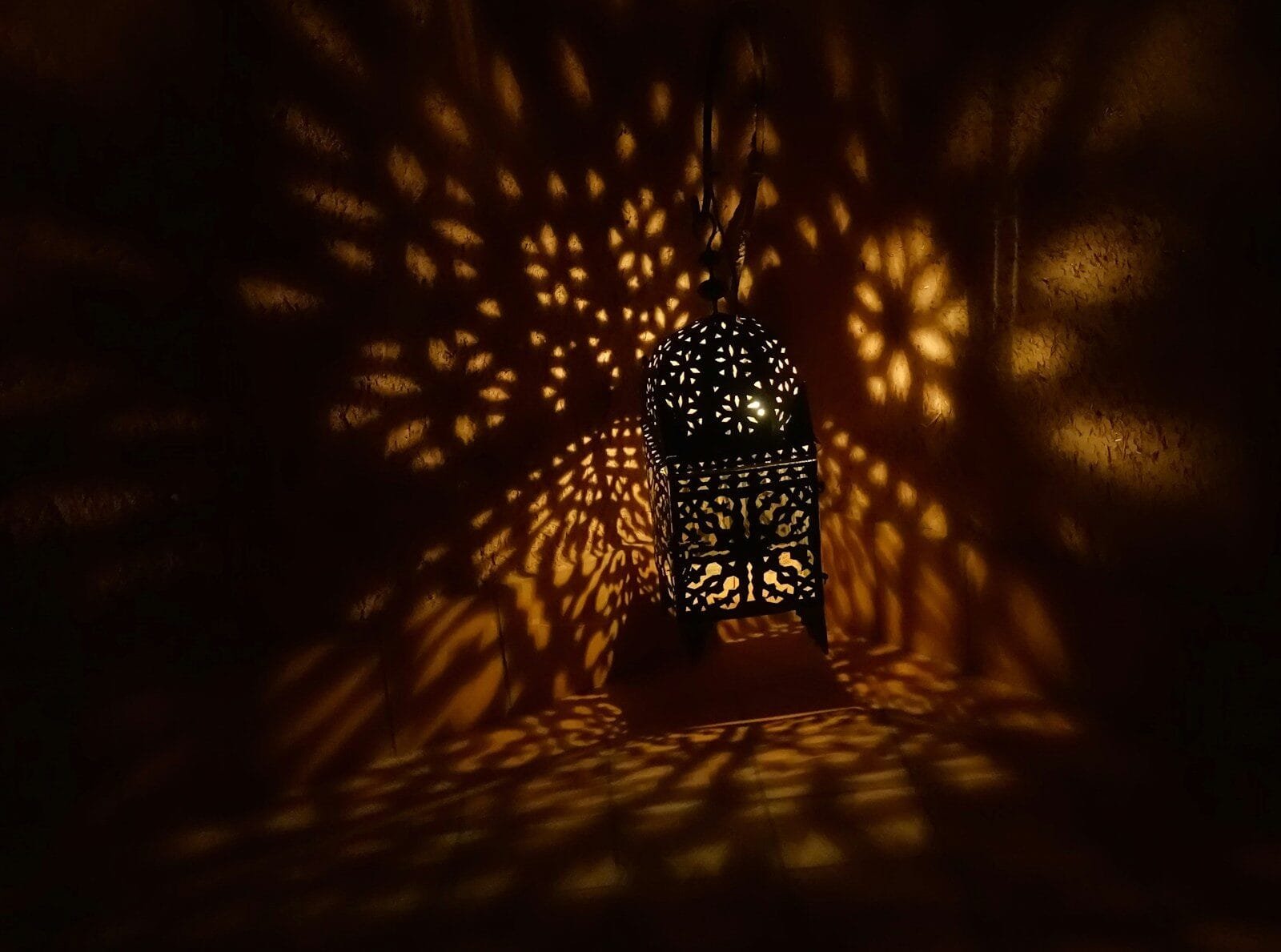
Watching a lantern come together in a workshop is one of the memorable experiences of a trip to Morocco. The process has barely changed in 500 years.
Step one: the sheet. The Maâlem starts with a flat sheet of brass or copper, usually 0.5 to 1 mm thick. He draws the pattern directly onto the metal with a pencil and a compass, working from memory or from a stencil passed down in the family.
Step two: the cut. Using a small hammer and a set of chisels called maziel, he punches every hole and cut by hand. A medium sized lantern with an intricate pattern takes 15 to 25 hours of chiseling alone. Larger commissioned pieces can take 40 hours or more.
Step three: assembly. The cut sheet is folded and soldered into the lantern shape. Common shapes include hexagonal, octagonal, teardrop, star (najma), and dome (qubba). The frame gets a door for candle access, or a socket if the piece will be electrified.
Step four: finish. Traditional finishes are raw brass (bright yellow gold color) or antique brass (a darker aged patina). Some lanterns get colored glass panels glued behind the metal cutouts. Cheaper mass produced lanterns skip this step entirely.
Step five: quality check. Real handmade lanterns show small variations. If you look inside a cutout and the edge is perfectly smooth, the piece was cut by machine. If the edge shows slight tool marks, it was cut by hand. Both look fine when lit, but the hand cut version is worth ten times as much.
10-day Morocco family tour
Imperial cities · High Atlas · one night under Saharan stars. Family-paced, private driver, kid-tested stops.
The Maâlem tradition
A Maâlem is not just a craftsman. It is a title, earned after years of apprenticeship, and it comes with responsibility for training the next generation. Most families that run lantern workshops in Fes and Marrakech have been doing this for four to eight generations. Watch a father teach his teenage son the chisel work and you understand why the pieces cost what they cost.
The main types of Moroccan lanterns
Not all Moroccan lanterns are the same. Understanding the categories helps you buy the right piece for the right space.
Ceiling lanterns (mishkat): The large hanging pieces most people picture. Range from 40 cm tall for a small hallway to over a meter for a grand riad courtyard. Usually electrified in modern versions.
Wall lanterns (applique): Half domes or full domes mounted on a plate, designed to sit flush against a wall. Common in Moroccan bathrooms, hallways, and staircase walls.
Table lanterns (qandil): Smaller pieces, 20 to 40 cm tall, designed to sit on a surface. Traditionally hold a candle. Great for dining tables and side tables.
Floor lanterns: Tall, freestanding pieces, often 80 cm to 1.5 meters tall. Placed in corners or beside seating areas. Cast dramatic shadows on nearby walls.
Star lanterns (najma): Eight or twelve pointed star shapes, either hanging or table sized. One of the most recognizable Moroccan silhouettes.
Teardrop lanterns: Elongated vertical pieces, popular in contemporary interiors. Often called the mishkat style even when smaller.
Ramadan lanterns: Smaller, colorful, sometimes plastic in the mass market versions. Traditional metal ones are made by the same workshops that produce year round lanterns.
The material matters as much as the shape. Brass is the standard, followed by copper (slightly redder tone) and wrought iron (heavier, more rustic look). Some workshops mix materials, using a brass frame with copper accents or camel bone inlay on the door.
Where to buy lanterns in Morocco?
The best place to buy lanterns in Morocco is at the source, which means the workshops in the Fes and Marrakech medinas. Airport shops and tourist boutiques mark up the same pieces by 200 to 400 percent.
Fes: The Seffarine Square (Place Seffarine) in the old medina is the coppersmith and brass district. Workshops line the square, and you can watch craftsmen at work while you shop. Prices tend to be lower than Marrakech, and the styles lean more traditional. Ask for a workshop that has been running for at least two generations.
Marrakech: The souks north of Jemaa el Fna have entire alleys dedicated to lanterns. Souk Haddadine (the blacksmith souk) and Souk Cherifia are the two main hubs. Prices are slightly higher than Fes, but the variety is bigger and the colored glass options are easier to find.
Tetouan and Chefchaouen: Smaller lantern scenes with more limited selection. Good for one off pieces if you happen to be in the north.
Essaouira: A few workshops on Rue Skala produce coastal styles with more silver and iron. Smaller scale than Fes or Marrakech.
Bargaining basics
Asking price is rarely the final price. Standard practice is:
- The first quote will be 2 to 3 times what the piece sells for locally
- Counter at about 40 percent of the asking price
- Settle somewhere in the middle
- Walk away if you disagree, they often come back with a better price
For larger pieces you plan to ship, negotiate the shipping into the total price before agreeing. Most established workshops handle international shipping and can quote both.
Watch for tourist knockoffs
Cheap mass produced lanterns from China have started to appear in tourist boutiques. Signs to spot them: perfectly smooth interior cuts, machine even patterns, extremely light weight for the size, and a smell of chemical paint rather than warm metal. A real handmade piece has slight asymmetry, weighs more than you expect, and smells faintly of brass polish.
How much are lanterns in Morocco?
This is a rough breakdown of what to expect for lanterns in Morocco based on size and quality.
Small candle lanterns (20 to 30 cm): 150 to 400 dirhams (roughly 15 to 40 US dollars). Simple geometric patterns, thin brass, single candle capacity. Good for outdoor terrace use or as gifts.
Medium hanging lanterns (35 to 55 cm): 500 to 2,000 dirhams (50 to 200 US dollars). This is the sweet spot for most buyers. Hand cut work, thicker brass, sometimes with colored glass inserts, and often already wired for electric bulbs.
Large ceiling lanterns (60 cm to 1 meter): 2,000 to 6,000 dirhams (200 to 600 US dollars). Serious pieces for entryways, dining rooms, or restaurant spaces. Fully hand cut, often with elaborate patterns and multiple layers.
Need help with transportation in Morocco?
Book a reliable private driver for your Morocco family adventure today — personalised routes designed just for you.
Very large statement pieces (over 1 meter): 6,000 to 25,000 dirhams (600 to 2,500 US dollars). Custom commissions, hotel scale pieces, and heirloom quality lanterns. Often shipped directly from the workshop.
Antique or vintage lanterns: 3,000 dirhams and up depending on age and condition. Fes has the most active market for these. Look for oxidized brass, hand engraved dates, and family provenance stories.
Shipping to Europe adds around 50 to 150 US dollars for medium pieces, and 200 to 400 US dollars for large ones. Shipping to the US adds slightly more. Most established workshops have relationships with DHL, FedEx, or the Moroccan postal service and can arrange the whole process.
Cash still gets you the best price. Card payments often come with a 3 to 5 percent surcharge, and some smaller workshops do not accept them at all. Bring enough dirhams for the buy, and remember that ATMs inside the medina charge fees.
Ramadan lanterns and their meaning
During the holy month of Ramadan, fawanees appear all over Morocco. In cities, they hang from balconies, over shop entrances, and outside mosques. In homes, families place them in courtyards, on rooftops, and near dining tables where iftar (the sunset meal that breaks the fast) is served.
The tradition traces back to 10th century Cairo. According to the most cited version of the story, when the Fatimid Caliph al-Muizz li-Din Allah entered Cairo on the fifth night of Ramadan in 969 AD, the people came out carrying lanterns to light his path. From that night forward, decorating with lanterns became part of Ramadan across the Islamic world.
In Moroccan practice, the Ramadan lantern carries several meanings:
Light in the darkness. Ramadan is a month of fasting from sunrise to sunset. The lanterns coming on at dusk signal iftar time and the end of the daily fast. The light itself becomes a marker of relief and reunion.
Hope and perseverance. Fasting is physically hard. The lanterns act as a visual reminder that spiritual growth continues even when the body is running low.
Family gathering. Fawanees mark the spaces where families come together to break fast, pray together, and read Quran. The soft light becomes part of the atmosphere.
Welcoming guests. Traditionally, families hung lanterns outside their homes to signal that visitors were welcome to share iftar. This custom is less common in modern cities but still practiced in rural areas.
If you travel to Morocco during Ramadan, the lantern displays in medinas turn on around 6 pm and stay lit until suhoor, the pre dawn meal. Photography during this time is best around blue hour, roughly 15 minutes after sunset, when the sky still has color and the lanterns already glow. Lanterns in Morocco take on their strongest cultural meaning during this month, so plan the trip around it if you can.
Turkish vs Moroccan lanterns: how to tell them apart
Both traditions are impressive and neither is better than the other. But they are different, and the difference matters if you want an authentic Moroccan piece.
Moroccan lanterns are built around metalwork. The pattern is cut directly into the brass or copper sheet. Light passes through the cutouts and projects shadows onto surrounding surfaces. Colored glass, when present, is used sparingly behind specific cutouts to add color accents.
Turkish lanterns are built around the glass. The metal frame is usually simpler, and the visual drama comes from mosaic glass work made up of hundreds of small colored glass pieces set into the frame. When lit, the whole lamp glows in a mix of colors rather than projecting patterns.
Other differences:
- Moroccan pieces tend to be larger and more geometric
- Turkish pieces tend to be smaller and more colorful
- Moroccan work is often unified in color (all brass, all copper)
- Turkish work uses many colors within a single piece
- Moroccan patterns are Islamic geometric or arabesque
- Turkish patterns are Byzantine or Ottoman in influence
If you are shopping and cannot tell, ask the shopkeeper. A real Moroccan artisan will happily explain the difference. If they cannot, the shop is probably reselling imports rather than making anything on site.
How to use a Moroccan hanging lantern in your interior
A Moroccan lantern is not a subtle piece. It commands attention. Placement matters more than with other lighting.
Entryways: A single hanging lantern in the foyer sets the tone for the whole house. Hang it at 2.1 to 2.3 meters from the floor for standard ceilings. For a two story entryway, drop it to 2.5 meters so it becomes the centerpiece.
Dining rooms: Above the dining table works if the ceiling is high enough. Bottom of the lantern should sit 75 to 90 cm above the table surface. In this position, the projected shadows move across the table during meals.
Living rooms: A pair of matching wall lanterns flanking a fireplace or a large piece of art creates symmetry. A single large ceiling lantern in the center of the room works if the ceiling is at least 2.7 meters.
Bedrooms: Table lanterns on nightstands, or a small hanging lantern in a corner. Avoid using them as primary lighting since the shadow patterns can be too active for sleep.
12 & 14-day grand family tours
Add Chefchaouen, the Atlantic coast, or two nights in the dunes. Slow mornings, shorter drives, room for grandparents and toddlers.
Bathrooms: A single wall lantern (applique) beside the mirror. Choose one with clear or amber glass rather than open cutouts to reduce moisture damage.
Outdoor spaces: Weather resistant iron or heavy brass lanterns for terraces and gardens. Solar candles work in place of real flames.
Bulb choice
- Warm white LED (2,700 to 3,000 K) works best for that authentic candlelight glow
- Avoid cool white (4,000 K or above), it kills the atmosphere
- Use dimmable bulbs if the lantern is your primary light source in a room
- Match wattage to lantern size: a small lantern needs a 4 to 6 watt LED, a large one 8 to 12 watts
Common mistakes to avoid
- Hanging too high, which loses the shadow projection
- Using ceiling fan lights or fluorescent bulbs, which flatten the light
- Placing the lantern against a plain white wall (shadows disappear)
- Overcrowding with other decorative pieces (the lantern needs breathing room)
Visiting a lantern workshop with kids
Moroccan lantern workshops make one of the best hands on stops on a family trip. Kids get to watch a Maâlem punch patterns into brass sheets, hear the constant tapping, and often try their hand at a simple design under supervision.
Good workshops for family visits:
- Fes: Association Ain Nokbi cooperative outside the medina
- Marrakech: The workshops in Souk Haddadine north of Jemaa el Fna
- Ourika Valley: A few small artisan cooperatives 45 minutes from Marrakech
What to expect:
- 30 to 60 minute visit
- Kids over six can usually try a simple hammer and chisel demo
- Younger kids can watch and choose a small lantern to take home
- Most cooperatives welcome tips (20 to 50 dirhams per family is standard)
- No pressure to buy, though most families end up with something
Bring a small notebook for kids to sketch patterns they see. Ask the Maâlem which pattern is his signature, and if there is one he learned from his father. Those stories stick with children long after the trip.
Safety note: brass workshops have hot metal, sharp tools, and heavy pieces. Keep kids under six close, and let the older ones try things only under the Maâlem’s direct supervision.
Getting your lantern home
Three ways to bring a lantern back from Morocco:
Carry it on the plane. Works for small and medium pieces (under 40 cm). Wrap in the workshop’s bubble wrap plus a scarf or spare clothing. Put it in your carry on, not your checked bag. Airport scanners handle brass fine, and customs generally do not question decorative art.
Check it in a suitcase. Works for medium pieces. Pack in the center of your suitcase surrounded by soft clothing. Brass dents more easily than you think. Foam corner protectors help.
Ship it. Best for large pieces or multiple lanterns. Established workshops handle DHL or FedEx directly. Costs 50 to 400 US dollars depending on size and destination. Shipping takes 5 to 15 business days.
Customs: Most countries allow personal decorative items duty free up to a threshold (roughly 800 US dollars for the US, 430 pounds for the UK). Keep the receipt in case customs asks. Antique pieces over 100 years old may need an export permit, which the workshop can arrange.
For families interested in bringing home a piece of Moroccan craftsmanship without the logistics stress, Morocco Vacation Planner builds workshop visits into custom tours and can arrange shipping through trusted artisans in the medina.
Final thoughts on lanterns in Morocco
Lanterns in Morocco are one of the few souvenirs that keep giving. Long after the tagine spice jar is empty and the leather bag has softened, the lantern above your dining table still casts its pattern of shadows across the ceiling every night. The pattern was cut by a Maâlem in Fes or Marrakech, by hand, from a design his grandfather taught him. That is a rare thing to have in a house.
If you are traveling to Morocco and think you might want one, plan for the workshop visit early in the trip. That way, you can go back for the piece you liked once you have seen more of the country and settled on your favorite. Ship the large pieces. Carry the small ones. Bargain in dirhams and pay in cash where you can.
If Ramadan overlaps with your trip, the whole country turns into a lantern gallery for a month. Even if you do not buy anything, walking through the Fes medina at dusk during Ramadan is one of those experiences that stays with you.
Morocco Vacation Planner designs Private Family Tours in Morocco for Kids, Teens & Toddlers. Plan your perfect family trip to Morocco with custom private tours built for families traveling with toddlers, kids, and teens. You get family friendly experiences, trusted local guides, and handpicked comfortable stays from the medinas all the way to the Sahara.
FAQs
What are Moroccan lanterns called?
Moroccan lanterns are called fanous (fanoos) in Arabic, with fawanees as the plural. Locally, specific types have their own names: mishkat for large ceiling lanterns, qandil for table pieces, and applique for wall mounted styles. The word fanous comes from the Greek phanos, meaning a portable source of light.
How much are lanterns in Morocco?
Prices for lanterns in Morocco run from 150 dirhams for a small candle lantern (about 15 US dollars) to over 25,000 dirhams for a large custom commissioned piece (2,500 US dollars). Medium hanging lanterns of good quality typically cost 500 to 2,000 dirhams (50 to 200 US dollars). Prices in Fes and Marrakech are lower than in Casablanca or airport shops.
What is the difference between Turkish and Moroccan lamps?
Moroccan lamps are built around metalwork, with patterns cut by hand into brass or copper sheets that project shadows onto surrounding walls. Turkish lamps are built around glass, with colorful mosaic pieces set into a simpler metal frame. Moroccan pieces tend to be larger and more geometric. Turkish pieces are smaller and more colorful.
What do lanterns mean in Islam?
Lanterns in Islam are associated with light as a symbol of hope, faith, and guidance. During Ramadan, the fanous marks the transition from fasting to iftar at sunset and appears on streets, homes, and mosques as a signal of celebration. The tradition dates to 969 AD, when the people of Cairo greeted the Fatimid Caliph with lanterns during the holy month.
How do you use a Moroccan hanging lantern in interior design?
Hang a Moroccan lantern where its shadow pattern has room to project onto walls or ceilings, ideally 2.1 to 2.3 meters from the floor in normal rooms and 75 to 90 cm above dining tables. Use a warm white LED bulb (2,700 to 3,000 K) for the authentic candlelight glow. Avoid plain white walls, which absorb rather than reflect the pattern.