Amazigh tattoo meanings
The first time I noticed the marks, I was sitting in a small house in the Middle Atlas with a glass of mint tea in my hand and an old woman across from me. She had three small green lines running down her chin and a faded diamond shape between her eyebrows. She caught me looking. Then she smiled, tapped the lines with her finger, and said one word in Tamazight that her granddaughter translated as marriage.
That is how most people learn about amazigh tattoo meanings in person, not from a book. The symbols sit on the skin of grandmothers in mountain villages, on the hands of women selling argan oil in coastal towns, and on the faces of a few remaining elders in the Sahara. Most of these women are now in their seventies and eighties.
This guide walks through what Amazigh tattoo meanings really are, why women wore them, which symbols matter most, how placement changes everything, and where you can still see this living history if you travel to Morocco with your family.
Quick takeaways
- Amazigh tattoo meanings in one line: Berber tattoos were never decoration alone. They marked identity, life stage, tribe, and spiritual protection.
- Mainly worn by women: The tradition was female centered, applied at puberty, before marriage, after childbirth, and during widowhood.
- The local name: In Tamazight the tattoos are called tichraḍ or ticeret, sometimes l’wasem in Moroccan Arabic.
- Common symbols: Triangles for fertility, crosses for the four directions, diamonds for protection, partridge eyes for guarding against the evil eye.
- Placement carries the message: A line on the chin can mean engagement, a mark on the nose can mean marriage or grief, a hand pattern can identify a tribe.
- Why it nearly vanished: Religious shifts after the 1970s and modern social pressure pushed the practice into rapid decline.
- Where you still find it: Atlas Mountain villages, the Anti Atlas, the Souss valley, and Saharan oasis towns still hold elderly tattooed women.
Why do Amazigh people get tattoos?
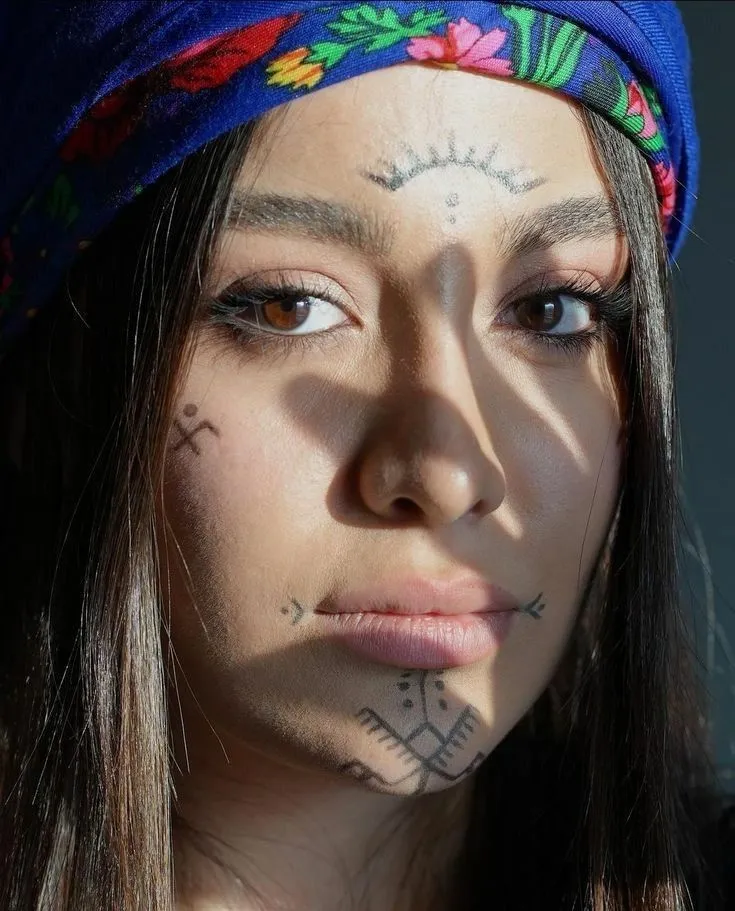
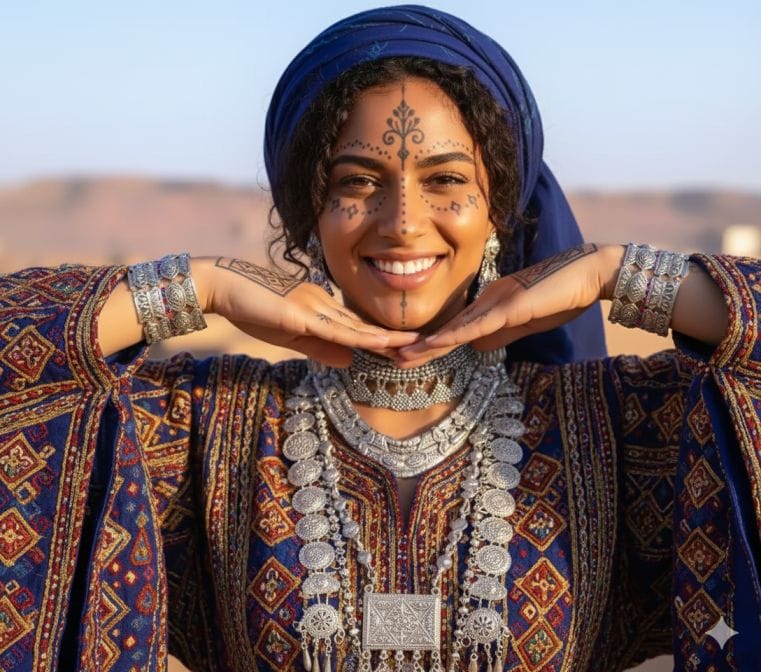
Amazigh people, especially women, traditionally got tattoos to mark identity, to invite spiritual protection, to record life events like marriage and childbirth, to belong visibly to a specific tribe, and to claim a form of beauty that long predates Islam in North Africa. The practice was never random or purely cosmetic.
The tattoos worked as a visual language on the body. Each mark answered questions an outsider might want to ask: who are you, which tribe do you come from, are you married, have you given birth, what has the spirit world promised to protect you from. In a society where most women did not read or write, the body itself became the document.
Spiritual protection was a major reason. Many Amazigh women received specific symbols to guard against the evil eye, to ward off illness, or to soften the pain of childbirth. Some patterns were thought to cure headaches, ease joint pain, or strengthen weak ankles. An elderly woman in a Souss valley argan cooperative once told me her chin tattoo kept her children safe through a hard winter when fever spread through the village.
Lifecycle reasons mattered too. A young girl received her first mark around puberty. A bride sometimes received additional marks before her wedding. Widows in certain regions had a line tattooed from ear to ear, in memory of a dead husband’s beard.
Regional and family meanings layered on top of these. Two villages a day’s walk apart could read the same triangle differently. So when you study Amazigh tattoo meanings, you are studying overlapping stories rather than a single fixed code.
Practical takeaways:
- Protection from the evil eye was the most common spiritual reason
- Tribal identity was readable on the skin, almost like a passport
- Life stages (puberty, marriage, motherhood, widowhood) each had their own marks
- Healing belief ran alongside symbolism, with some tattoos seen as folk medicine
- Beauty mattered too, but always layered with one of the meanings above
If you want to see this tradition firsthand, Morocco Vacation Planner can arrange a slow afternoon in an Atlas village home where an elderly tattooed woman shares tea, stories, and her own personal Amazigh tattoo meanings.
What Amazigh tattoos really are
Amazigh tattoos are a form of indigenous body marking that goes back at least two thousand years across North Africa. The Amazigh, sometimes called Berbers, are the original inhabitants of the region that now includes Morocco, Algeria, Tunisia, Libya, and parts of Mauritania, Niger, and Mali. In Tamazight, the tattoos are usually called tichraḍ or ticeret.
The lines have purpose. Each tattoo is part of a larger system that connects the body to family, tribe, season, fertility, and spirit. You can find the same shapes on Berber rugs, in silver jewelry, in pottery, and carved into the wooden doors of old houses. The skin was one more surface for the same visual vocabulary.
Cynthia Becker, in her 2006 book Amazigh Arts in Morocco, points out that women both created the symbols and wore them. That double role gave women a quiet form of authority in a society where many other public roles were closed to them.
The colors are usually faded blue or green, with some marks looking almost black. That comes from the ink mix used historically, which combined soot or charcoal with green plants and animal fat. Once under the skin, the carbon read as blue or green against darker complexions.
What sets Amazigh tattoo meanings apart from many modern tattoos is that the wearer rarely chose the design alone. An older woman in the family or the village, sometimes called the tattoo woman or the seyyala, picked the symbol based on the girl’s age, her tribe, her mother’s lineage, and the protective needs of the moment.
That is why the same diamond can mean home to a Tashelhit speaker in the Souss valley and protection of a child to a Tarifit speaker in the Rif. The meaning sat inside the relationship between the wearer, the tattoo woman, and the village.
A short history of Amazigh tattoo meanings
The roots of Amazigh tattoo meanings go back further than written North African history. Archaeological work on Libyco Berber sites and rock art shows geometric symbols that match later tattoo motifs by thousands of years. The earliest Greek and Roman writers who described the people of the region, including Herodotus, mentioned body marking as a tribal practice.
The tradition was firmly in place before Islam arrived in the seventh and eighth centuries. That timing matters. Amazigh tattoos predate Islamic teaching by a long stretch, which is why religious objections to them are a relatively recent layer in a much older history.
Through the medieval period, tattooing remained common across rural North Africa. French ethnographers documenting Morocco in the early twentieth century found tattooed women in nearly every Amazigh region they visited. Photographs from the 1930s and 1940s show women with full chin patterns, forehead diamonds, and hand designs.
The middle of the twentieth century is when things began to shift. As Morocco urbanized in the 1960s, younger women moved to cities and stopped getting tattooed. The rise of more conservative Islamic interpretations from the 1970s onward put further pressure on the practice. Tattooing came to be classified by many imams as haram, forbidden, because it alters the body God gave the believer. Some older women later had laser removal done, and many have spoken with regret about their marks.
What survived is mostly held in memory. The grandmothers who carry these marks are now in their seventies, eighties, and nineties. When they pass, much of the lived knowledge of Amazigh tattoo meanings goes with them, which is why current research and revival projects feel urgent to people working in the field.
10-day Morocco family tour
Imperial cities · High Atlas · one night under Saharan stars. Family-paced, private driver, kid-tested stops.
The Amazigh diaspora in Europe has started to push back. Artists like Raissa Lei have created projects that pair young Amazigh women with traditional symbols, often in temporary form, so they can carry the visual language even if they choose not to make it permanent.
What the colonial archives recorded
In the French Protectorate years (1912 to 1956), several anthropologists documented Berber tattoo patterns in painstaking detail. Jean Herber, a French doctor working in Morocco in the 1920s, collected drawings of more than three hundred Amazigh tattoo motifs and published them in a series of papers in the Hespéris journal. His work remains one of the most important written records, even though he often misread the meanings through a European lens.
For modern researchers, the colonial archive is both useful and limited. Useful because the drawings preserve symbols that have since vanished. Limited because the men taking the notes rarely spoke with the women whose bodies they were studying.
The most common Amazigh symbols and what they mean
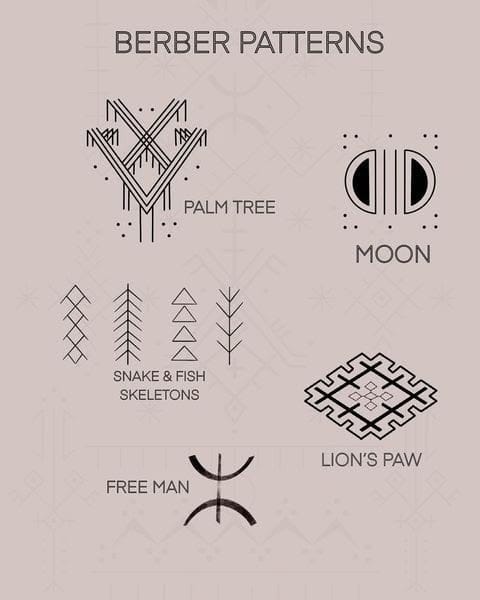
The symbols come next. These are the marks you are most likely to recognize if you spend time looking at older photographs or talking with elderly women in the Atlas.
The triangle and the diamond
The triangle is one of the most common shapes in Amazigh tattoos. Pointing down, it represents the womb and femininity. Pointing up, it can stand for masculinity, strength, or fire. When the two combine, they form a diamond, which carries the meaning of balance between male and female, and is also read as the eye in many regions, a guard against evil influence.
The diamond appears often on the chin, the forehead, and the hands. It can also stand for the home, especially when it has small extensions at its corners that look like rooftops or doors.
The cross and the four directions
The cross in Amazigh tattoos has nothing to do with Christianity. It predates the religion in this region by centuries. The four arms point to the four cardinal directions and connect the wearer to the cycle of the seasons, the four winds, and the natural world.
A cross on the forehead was sometimes used in folk medicine to prevent migraines. A cross between the eyebrows was sometimes added at puberty as a general protection mark.
Eyes, partridge feet, and the evil eye
Many of the smallest marks carry the heaviest meaning. The eye, often a small almond shape with a dot inside, defends against the evil eye, called el aïn in local speech. The partridge eye, a small set of three dots, draws on the bird’s reputation for grace and watchfulness. The partridge foot, three short lines arranged like a bird’s track, calls in protection during travel and movement.
Animal motifs: snake, fly, and gazelle
Animal symbols carry the qualities of the animal into the wearer. The snake brings virility and a slow patience. The fly, despite its lowly reputation, stands for the ability to survive anywhere, which traders and travelers wanted on their skin. The gazelle, occasionally tattooed by Saharan Amazigh women, brings grace and beauty.
What an Amazigh face tattoo means by placement
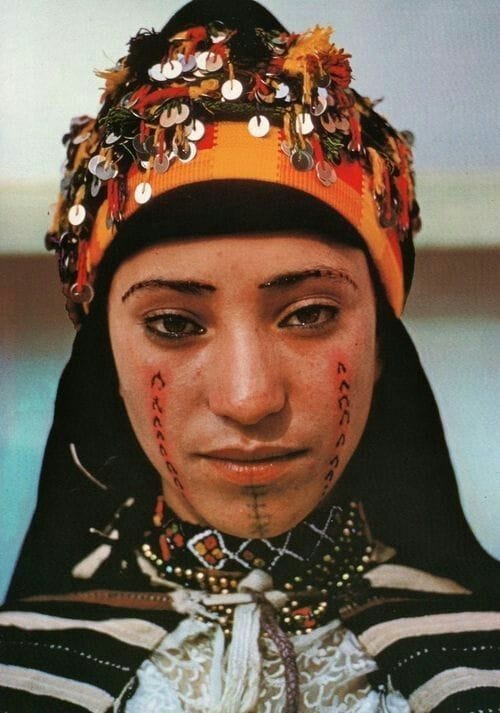
Where the mark sits on the body changes everything. A symbol on the chin reads differently from the same symbol between the eyebrows. Anyone trying to learn Amazigh tattoo meanings has to read the position together with the shape.
Chin tattoos
The chin is the most common place for Amazigh face tattoos in Morocco. A vertical line, especially when paired with three small dots, often marks an engagement. A line that runs from the lower lip to the bottom of the chin can signal marriage. After widowhood, some women in southern regions add a line that stretches sideways toward the ears, said to represent the dead husband’s beard.
Forehead tattoos
The forehead is where women place marks meant for wisdom, mental health, and migraine relief. A small cross between the eyebrows is the most common. A diamond on the forehead carries strong protective meaning, often given to a girl during a serious illness or to a woman after a difficult birth.
Cheek and nose tattoos
Cheek marks are mostly tribal. A particular dot pattern on the cheekbone might tell another Amazigh woman exactly which valley you come from. A mark at the tip of the nose can mean marriage in some regions, or it can mean the loss of a child in others. That is a difference outsiders almost always miss.
Hand, wrist, ankle, and chest tattoos
Hand tattoos are the most varied. They often combine tribal identity with daily protection, since the hands do the cooking, the cleaning, the weaving, and the carrying of children. Wrist and ankle marks help with movement and travel. Chest tattoos, when present, are usually maternal symbols related to nursing.
The body in this tradition is mapped like a country. The chin holds identity, the forehead holds thought, the hands hold work, the feet hold motion.
Why Amazigh tattoo meanings differ between regions
If you read three different sources on Amazigh tattoo meanings, you will see three slightly different lists. That is not because the sources are wrong. It is because the tradition was never centralized.
The Amazigh world stretches from the Atlantic coast of Morocco to the western edge of Egypt, and from the Mediterranean down into the Sahel. Inside that area, the language alone splits into several major branches, including Tashelhit in the south of Morocco, Tamazight in the central Atlas, Tarifit in the Rif, Kabyle in Algeria, and Tuareg further south.
Need help with transportation in Morocco?
Book a reliable private driver for your Morocco family adventure today — personalised routes designed just for you.
Each branch carries its own tattoo tradition.
In the Souss valley, a Tashelhit speaking grandmother might wear a small palm tree on her forehead. The same symbol in the Rif might be a stylized lightning mark with a different meaning. In the Atlas, the diamond is often the eye of protection. In the Anti Atlas, the same diamond might be read as the house and family stability.
The Tuareg, who live in the deep Sahara, kept tattoo traditions longer than their northern cousins, partly because Saharan isolation slowed the religious and social pressures that ended the practice elsewhere.
A short list of regional patterns I have come across personally:
- Souss valley: palm tree motifs, three small lines on the chin for a married woman
- Middle Atlas: heavy use of the cross between the eyebrows, often combined with a diamond
- Anti Atlas: linked diamonds across the chin in chain form, for protection and tribal identity
- Rif Mountains: small angled lines on the temples, often associated with widowhood
- Saharan oases: simpler, larger forms, with a strong place for the snake and gazelle
So when you read a single chart of symbols online, treat it as a starting point rather than a dictionary. The most accurate readings come from someone who knows the village, the family, and the year the tattoo was made.
How the tattoos were made
The tools were simple, the ritual was elaborate. Tattooing was not a quick salon visit. It was a community event that could last several hours.
The tattoo woman, often an older member of the household or a respected elder from a neighboring village, sketched the design first with kohl or with a natural dye. Then she pricked the skin along the lines, using a thorn from an acacia tree, a sewing needle, or sometimes several needles bound together with thread.
After the punctures, she rubbed in a paste made of soot, ash, or herbs. The mixture stayed under the skin as it healed, and the resulting line carried a blue green tint that lasted for life.
Healing took about a week. During that time, the women of the family gathered around the girl. They told stories, gave advice on married life or motherhood, sang songs, and rubbed the swollen area with olive oil or argan oil to ease the pain.
This ritual aspect is one reason the tattoos cannot be separated from the social moment in which they were given. The mark on the skin is the visible remainder of a longer process.
Children who watched their mothers and grandmothers go through this absorbed the meaning of each shape long before they had any of their own. That is how the system passed down across generations, without written manuals.
The needles and thorns were often cleaned in a small fire before use. Hygiene was not modern, but in many villages the tattoo woman knew which plants to crush into the wound to prevent infection. Septicemia and serious complications were rare in the records I have read.
Why the practice has nearly disappeared
I have asked dozens of older Amazigh women about their tattoos. Many love them. Some hate them. Almost all of them are the last in their family to have any.
A few reasons stack on top of each other.
First, the religious factor. From the 1970s onward, more conservative readings of Islam took hold in rural Morocco. Tattoos came to be classified by many imams as haram, forbidden, because they alter the body God gave the believer. Some women had removal done. Many others stopped getting them in the first place. Their daughters never received the marks.
Second, the urbanization factor. As young women moved to cities for work and education, the village rituals that produced tattoos faded. A girl who lived in Casablanca at sixteen would not be sitting in her grandmother’s kitchen for a chin tattoo session.
Third, the modernity factor. Many young Moroccans came to see facial tattoos as old fashioned, even backward, in a country that was looking outward. The same girls who would wear silver Amazigh jewelry with pride often did not want the marks on their face.
Fourth, the colonial gaze factor. French and Spanish observers in the early twentieth century sometimes wrote about tattooed Berber women in ways that exoticized or pathologized them. Some Amazigh communities internalized that gaze and turned away from the practice.
The result is a quiet loss. There are no protests, no court cases, no headlines. The practice simply did not pass to the next generation, and one or two more decades will likely close the chapter on traditional tattooing as a lived custom.
That is why writing about this tradition now matters more than writing about it a century ago would have. The window is short.
Amazigh tattoo meanings today and the modern revival
The story is not one of disappearance alone. A revival is happening, slowly, mostly outside Morocco and mostly among the Amazigh diaspora in France, Belgium, the Netherlands, and Canada.
Young Amazigh women in Europe have started commissioning small symbol tattoos on their wrists, shoulders, or ankles. The choice is usually personal. A wrist diamond in memory of a grandmother. A small cross between the shoulder blades for protection. A line of three dots on the inside of the forearm as a quiet nod to identity.
12 & 14-day grand family tours
Add Chefchaouen, the Atlantic coast, or two nights in the dunes. Slow mornings, shorter drives, room for grandparents and toddlers.
Inside Morocco itself, the revival is more cultural than personal. You see Amazigh symbols on T shirts, on jewelry, in henna designs at weddings, on the walls of new restaurants in Marrakech and Rabat. The marks live everywhere except on faces.
Some Amazigh artists work specifically to keep this knowledge alive. The Tifinagh script, which is the original Amazigh writing system, is now taught in some Moroccan schools. Festivals like the Imilchil wedding moussem and the Timitar festival in Agadir bring together elders whose tattoos are part of the public memory.
If you are interested in Amazigh symbols as a wearer rather than just an observer, the most important step is research. Speak with Amazigh women, not just artists. Read books written by Amazigh authors, like Cynthia Becker’s work on Berber women shaping identity. Understand that some symbols carry meanings that should stay with the community of origin.
For a respectful approach, a few guidelines worth keeping in mind:
- Avoid combining symbols from different Amazigh regions if you do not understand each one
- Skip face placements unless you have a direct family or community connection
- Ask an Amazigh artist when possible rather than a general tattoo studio
- Read more than one source, since the meanings shift between villages
The respectful path is narrower than the trendy one. It is also far more interesting.
Seeing this tradition with your family in Morocco
Reading about these tattoos is one thing. Seeing them on the face of a woman pouring tea in her own kitchen is another. Traveling with kids and teens is one of the best ways to bring a tradition like this to life. Kids ask the questions adults are too polite to ask. They notice the marks first.
A few places where families can still encounter Amazigh tattooed women and the cultural context around them.
Atlas Mountain villages
A homestay or guided visit in the Middle Atlas (around Imilchil, Azrou, or Aït Bouguemez) often includes time in a Berber household where an older woman with tattoos may be present. Older women are usually happy to talk if you have a guide who can translate and who has earned local trust.
The Souss and Anti Atlas
The argan oil cooperatives around Essaouira, Tafraoute, and Tiznit are often run by women’s collectives. Some of the older members wear traditional tattoos. The cooperatives generally welcome family visits and explain the work.
Saharan oases
Merzouga and M’Hamid still have older Amazigh and Saharan women who carry the older marks. A camel trek with a quality guide can include a stop at a family home where children can meet women whose tattoos tell a different story from anything in a Marrakech souk.
Museums and cultural centers
For families who want context before they meet anyone, the Berber Museum at the Jardin Majorelle in Marrakech holds photographs, jewelry, and explanatory panels. The Boumalne Dadès Berber cultural center is smaller but more local in feel.
This is where Morocco Vacation Planner can help. We design Private Family Tours in Morocco for kids, teens, and toddlers. The trips include child friendly experiences, trusted local guides who can interpret these encounters with care, and handpicked comfortable stays that move you from medina life all the way to the Sahara. Plan your perfect family trip and let your kids meet the women who carry this living history on their skin.
Final thoughts on Amazigh tattoo meanings
The marks on the skin of older Amazigh women are one of the few remaining places where pre Islamic North African belief sits in plain sight. They tell stories of marriage and widowhood, of childbirth and illness, of belonging to a tribe that may itself be smaller now than it was a century ago.
If your interest in Amazigh tattoo meanings comes from travel, the best thing you can do is meet the women themselves while it is still possible. Bring questions. Bring patience. Bring children, since their curiosity often opens doors that an adult’s caution closes.
If your interest comes from a desire to wear one of these symbols yourself, slow down. Read more than one source. Speak with an Amazigh person if you can. Treat the choice the way you would treat using a phrase from someone else’s grandmother’s language. Respect first, decoration second.
Morocco Vacation Planner designs Private Family Tours in Morocco for kids, teens, and toddlers. We build itineraries that put your family inside Atlas homes, argan cooperatives, and Saharan camps where this tradition still breathes. Plan your perfect family trip with custom private tours built for families traveling with toddlers, kids, and teens. Trusted local guides, handpicked comfortable stays from the medinas to the Sahara, and the chance for your children to meet a few of the grandmothers who carry centuries of meaning on their skin.
FAQs about Amazigh tattoo meanings
What is the Amazigh symbol?
The most widely recognized Amazigh symbol is the yaz (ⵣ), a stylized human figure with arms raised, which represents the free human and gives the Amazigh their name. Amazigh translates as free or noble. Beyond the yaz, the Tifinagh script and the diamond, cross, and triangle motifs are the symbols most often used in jewelry, rugs, and the Amazigh tattoo meanings discussed above.
What is the meaning of a Berber tattoo?
A Berber tattoo’s meaning depends on the symbol, the placement, the region, and the wearer’s stage of life. The general categories are protection (especially from the evil eye), tribal identity, life transitions like marriage or motherhood, and folk healing. To read any specific tattoo, you usually need all four pieces of information.
What is the meaning of tattoos in the Amazigh tribe?
The Amazigh are not a single tribe but a family of peoples across North Africa. Within Amazigh communities, tattoo meanings cluster around protection, identity, fertility, and rites of passage. The exact reading shifts by village and family, which is why Amazigh tattoo meanings should be approached as a regional system rather than a single code.
Why do Amazigh women wear face tattoos?
Amazigh women wore face tattoos for spiritual protection, to mark life events like engagement or marriage, to show tribal belonging, and as a culturally accepted form of beauty. Face tattoos were traditionally given by older women in the family or village, usually starting at puberty and added to over a lifetime.
Do men in Amazigh culture get tattoos?
Tattoos were primarily worn by women, but Amazigh men in some regions did receive smaller tattoos, often on the wrist, temple, or hand. Modern Amazigh tattoo meanings for men tend to focus on tribal identity, Tifinagh script letters, or symbols of strength and free identity.