The first thing most travelers worry about before a trip to Morocco is the obvious one: which airport do you fly into? With cities scattered across mountains, coast, and desert, the wrong choice can cost you a full day of driving you did not plan for. The major airports in Morocco are not interchangeable. Each one opens up a different part of the country, and each one has its own personality.
This guide walks you through the major airports in Morocco from a practical, on-the-ground angle. You will learn which airport handles the most international flights, which one drops you closest to a medina, which ones work best for family arrivals with sleepy toddlers, and which smaller airports are worth knowing about if you want to skip a long road transfer. We will cover Casablanca, Marrakech, Fes, Tangier, Agadir, Rabat, and the regional gateways that serve the Sahara and the north.
Quick Takeaways
- Casablanca handles the most flights: Mohammed V International (CMN) is the busiest of the major airports in Morocco, with the widest long-haul network and the only direct flights from North America.
- Marrakech sits closest to its city center: Just 6 km from the medina, Marrakech Menara (RAK) is often the easiest landing for first-time visitors.
- Five international hubs cover most needs: Casablanca, Marrakech, Fes, Tangier, and Agadir together carry more than 85 percent of international passenger traffic.
- Smaller airports save real driving time: Oujda, Nador, Ouarzazate, Essaouira, and Dakhla can shave a full day off some itineraries.
- All airports are managed by ONDA: The Office National Des Aéroports oversees safety, standards, and most ground services across the country.
- Trains and taxis vary widely: CMN has its own train station, while smaller airports rely on grand taxis or pre-arranged transfers.
- Family-friendly basics: Strollers, baby food, and water are easy to find in CMN and RAK, less so in regional terminals.
What are the main airports in Morocco?
The main airports in Morocco are Mohammed V International in Casablanca (CMN), Marrakech Menara (RAK), Fes Saiss (FEZ), Tangier Ibn Battouta (TNG), Agadir Al Massira (AGA), and Rabat-Salé (RBA), with several smaller international gateways rounding out the network. Together these six count as the major airports in Morocco, and they handle the overwhelming majority of international and domestic passenger traffic in the country.
The country has roughly 19 international airports and around 14 smaller domestic strips, all overseen by the Office National Des Aéroports, known by the French acronym ONDA. Casablanca’s Mohammed V serves as the central long-haul hub, while Marrakech Menara dominates tourist arrivals from Europe. The other major airports in Morocco (Fes, Tangier, and Agadir) each pull strong European traffic, especially from France, Spain, the UK, Belgium, and the Netherlands.
For a deeper trip into the south, smaller airports like Ouarzazate (OZZ), Errachidia, Essaouira-Mogador, and Dakhla open up the desert and the Atlantic coast without forcing a long drive from the larger cities. In the north, Nador and Al Hoceima serve the Rif region and the Mediterranean coastline.
However, “main” depends on your trip. A family with toddlers heading to a riad in the Marrakech medina will treat RAK as their main entry, regardless of how many flights CMN handles. A culture-focused traveler aiming for Fes el Bali might pick FEZ over either of the others. The honest answer is that the main airport for you is the one closest to where your trip actually starts.
Practical takeaways:
- CMN works best for long-haul flights and for routes that begin or end in Casablanca or Rabat
- RAK is the call for trips centered on Marrakech, the Atlas, or the Sahara
- FEZ wins for itineraries built around Fes, Chefchaouen, or the north interior
- TNG suits Mediterranean and ferry-linked trips into Spain
- AGA is the choice for beach and surf trips around Agadir, Taghazout, and Essaouira
If you are planning a family trip, our team at Morocco Vacation Planner matches families to the airport that fits the route, not just the cheapest fare, so you arrive close to your first hotel rather than three hours away from it.
Mohammed V International Airport (CMN), Casablanca
Casablanca’s Mohammed V is the heavyweight. If you have flown in from New York, Montreal, Dubai, Sao Paulo, or anywhere else outside Europe, this is almost certainly where you landed first. CMN handled over 14 million passengers in 2024, putting it among the top five busiest airports on the African continent. Royal Air Maroc bases its hub here, and you will see most major European carriers, Emirates, Turkish Airlines, Qatar Airways, and Saudia all running daily flights through the terminals.
The airport sits about 30 kilometers south of downtown Casablanca, in the Nouasseur area. Three terminals handle the traffic. Terminal 1 was renovated in 2019 and feels modern, with bright halls, plenty of seating, and decent food. Terminal 2 takes the bulk of Royal Air Maroc flights. Terminal 3 has been mostly used for charter and overflow operations.
What sets CMN apart from the other Moroccan airports is the train. A direct line connects the airport to Casa Voyageurs in central Casablanca in about 40 minutes, and from there you can catch the high-speed Al Boraq to Rabat in 50 minutes or Tangier in roughly two hours. No taxi haggling, no traffic risk. The platform sits on the basement level just below arrivals.
For families with strollers, the lifts work, the train doors are wide, and the platform has staff who help with luggage. Pack snacks for the kids, because the train station inside the airport is light on food options if you arrive at off-peak hours.
When CMN is the smart pick
- Long-haul arrivals from North America, the Gulf, or Asia
- Trips starting in Casablanca, Rabat, or the Atlantic coast
- Travelers using the train network down to Marrakech or up to Tangier
- Business trips with meetings in the capital
Marrakech Menara Airport (RAK)
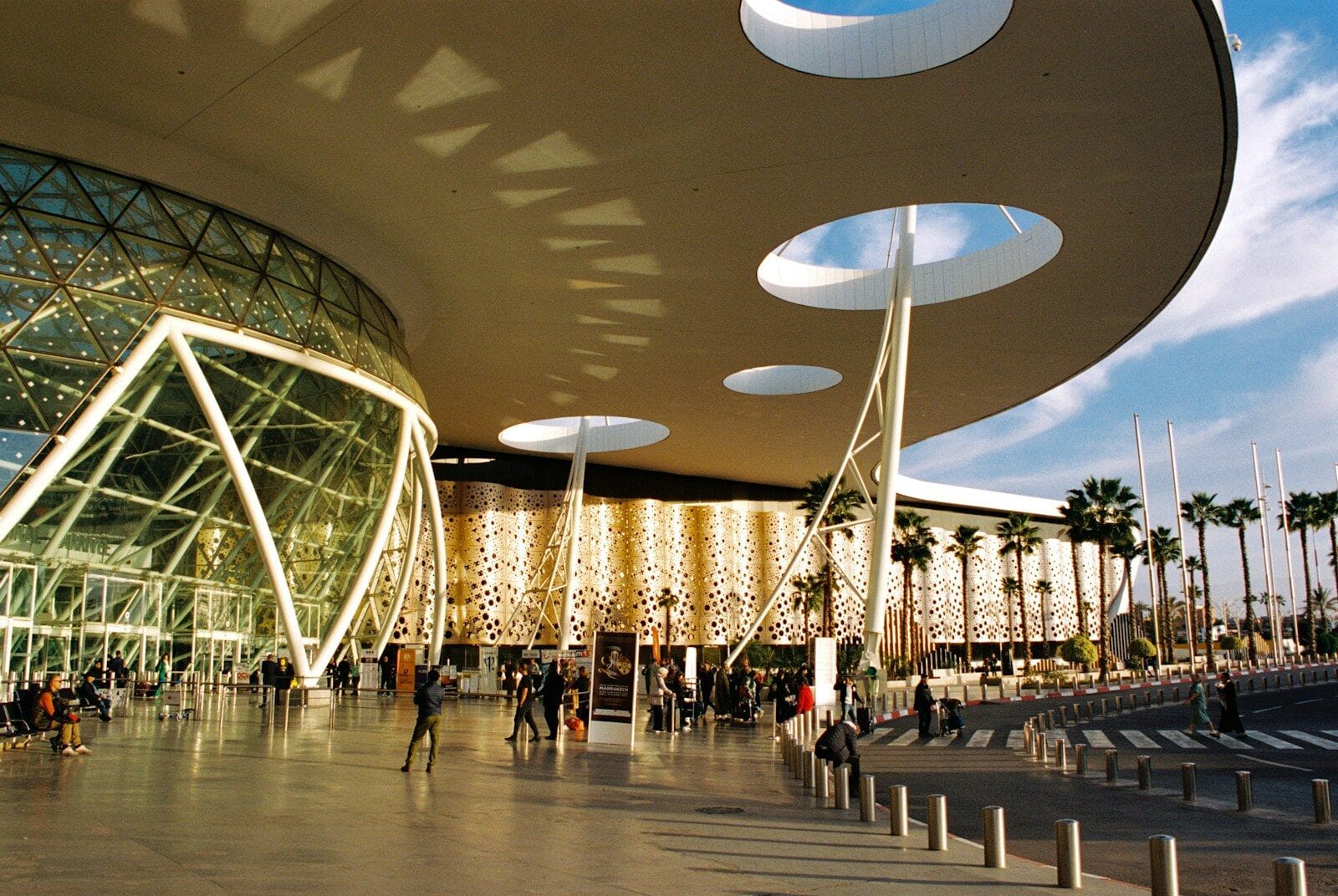
If your dream trip is the classic version of Morocco with souks, riads, and sunset on a rooftop, then Marrakech Menara is where you want to land. It is the second busiest of the major airports in Morocco, handling more than 6.7 million passengers in 2024 across two terminals. The runway sits just six kilometers from Jemaa el-Fnaa, the main square in the medina. You can be sipping mint tea on a rooftop within 30 minutes of clearing customs.
The terminal itself is one of the prettier ones in North Africa. Geometric mashrabiya screens filter the light, and the white arches inside feel cool even on a 40 degree day. Ryanair, easyJet, Transavia, and Royal Air Maroc dominate the routes here, with frequent flights from London, Manchester, Paris, Brussels, Madrid, Marseille, and Milan. Direct service from the United States is rare, so most American travelers connect through Casablanca, Paris, Madrid, or Lisbon.
What to expect on arrival at RAK
- Immigration moves faster than at CMN, especially before 11am
- Official taxis sit in a marked rank just outside arrivals (insist on the meter or agree on the fare first)
- The metered fare to a riad inside the medina is usually 100 to 150 dirhams in daylight, more at night
- Free Wi-Fi works in most public areas
- A small play area sits near the departures hall for kids waiting for connecting flights
Be aware that the airport gets crowded during European school holidays, especially Christmas and Easter. If you are flying out of Marrakech then, arrive at least three hours before your scheduled departure. Security lines double when several flights leave back to back.
10-day Morocco family tour
Imperial cities · High Atlas · one night under Saharan stars. Family-paced, private driver, kid-tested stops.
Fes Saiss Airport (FEZ)
Fes is often the smart second choice that experienced travelers pick over Marrakech, especially for slow culture trips. Fes Saiss Airport sits about 15 kilometers south of the old city, and it handles direct flights from France, Spain, Italy, Belgium, and the Netherlands. It is smaller than the other major airports in Morocco, which works in your favor: bag claim is fast, immigration usually takes 15 to 25 minutes, and the taxi queue is short.
If your itinerary leans toward Fes el Bali, Chefchaouen, Meknes, or Volubilis, flying into FEZ saves you a six hour drive from Casablanca or seven hours from Marrakech. That alone makes it worth a slightly higher fare for many travelers.
Family notes for Fes
- Change a little cash at the airport for taxi tips and water (about 20 to 30 euros is usually enough for arrival day)
- The drive from FEZ to a riad in the medina takes 25 to 35 minutes depending on traffic and which gate (bab) you are heading toward
- The medina cannot be entered by car, so taxis drop you at the closest gate and a porter or your riad’s team usually meets you on foot
- Stroller travel inside the medina is hard because of stairs and cobbles; consider a soft carrier for toddlers
Royal Air Maroc, Ryanair, Air Arabia, and TUI Fly cover most European routes. Long-haul travelers from outside Europe typically connect through Casablanca, Madrid, or Paris. Food choices inside the terminal are limited, so eat before you fly or grab something during your connection.
Tangier Ibn Battouta Airport (TNG)
Tangier’s airport carries the name of the great medieval Moroccan traveler Ibn Battuta, who covered more ground than Marco Polo. The airport sits about 14 kilometers southwest of the city and serves northern Morocco, the Mediterranean coast, and the gateway to Spain. Ferries from Tanger Med port connect to Algeciras and Tarifa, making TNG one of the best options for travelers combining Morocco with Andalusia.
Ryanair, Vueling, Iberia Express, easyJet, and Royal Air Maroc run frequent flights from Madrid, Barcelona, Paris, Brussels, Amsterdam, and several UK cities. Traffic peaks in summer and slows to a trickle in winter.
The airport itself is small and easy to manage. Two boarding gates, one main hall, and a short walk between security and the gate. Families with young kids find it less stressful than CMN or RAK because crowds are smaller and queues move quickly.
When to fly into Tangier
- Trips combining Morocco and Spain by ferry
- Visits to Chefchaouen, Tetouan, or the Rif Mountains
- Travel during the summer months when northern Morocco stays cooler than the interior
- Quick weekend trips from Madrid, Barcelona, or Seville
A new high-speed Al Boraq train connects Tangier with Rabat and Casablanca in roughly two hours, so even if you land in TNG you can still reach the political and economic centers of the country in an afternoon.
Agadir Al Massira Airport (AGA)
If your trip is built around beaches, surf, or winter sunshine, Agadir Al Massira is your gateway. The airport sits about 25 kilometers from Agadir and 35 kilometers from Taghazout, the surf town that has been growing year after year. In 2024 the airport handled more than 2.8 million passengers, with about 26 airlines flying in from 65 destinations. Of all the major airports in Morocco serving leisure travelers, AGA carries the highest share of charter flights.
Agadir gets reliable winter sun, with daytime temperatures rarely dropping below 18 to 20 degrees Celsius even in December and January. That is why charter flights from northern Europe pack the runway between November and March. EasyJet, Ryanair, TUI Fly, Transavia, and Eurowings all run heavy routes here.
The terminal is compact and modern, with a small kids’ play area, a few cafes, and rental car desks for the major chains. If you are renting a car at the Agadir airport, expect a 10 minute shuttle ride to the rental lot. Pre-book the car seat if you are traveling with kids; the desks rarely have enough on hand during peak season.
Driving from AGA
- Agadir city center: 30 to 40 minutes
- Taghazout: 35 to 45 minutes
- Essaouira: about 2.5 to 3 hours
- Marrakech: 3 to 3.5 hours via the new A7 motorway
Most family resorts along the Atlantic coast (Sofitel, Riu Tikida, Robinson, ClubMed) arrange airport transfers as part of the booking. It is worth asking before you commit to a separate taxi.
Smaller International and Regional Airports
Beyond the big five, several smaller international airports quietly handle a meaningful share of traffic and can save you serious driving time depending on your route.
Rabat-Salé Airport (RBA)
The capital’s airport handles diplomatic and business travel mostly, with limited but useful international service to Paris, Brussels, Madrid, and Tripoli. It is small, calm, and only 10 kilometers from central Rabat.
Nador Al Aroui Airport (NDR)
Serves the Mediterranean coast in northeast Morocco and the Spanish enclave of Melilla. Heavy diaspora traffic during summer holidays.
Oujda Angads Airport (OUD)
Northeast Morocco’s main gateway, with flights to Paris, Brussels, Marseille, Amsterdam, and other European cities serving the large Moroccan community abroad.
Need help with transportation in Morocco?
Book a reliable private driver for your Morocco family adventure today — personalised routes designed just for you.
Ouarzazate Airport (OZZ)
The gateway to the Sahara, Aït Ben Haddou, and the film studios known as “Moroccan Hollywood.” Limited international service but useful for shaving a full day off desert itineraries.
Essaouira Mogador Airport (ESU)
Small and charming, with seasonal European service. Ideal for travelers heading straight to the windy Atlantic coast town of Essaouira.
Dakhla Airport (VIL)
Deep in the southern part of the country, this airport serves the kitesurfing and water sports community heading to the Dakhla Lagoon.
Al Hoceima Airport (AHU)
A coastal Mediterranean airport serving the Rif region with mostly seasonal European charter service.
Among the major airports in Morocco, these smaller ones rarely make headlines, but they are the secret weapon of well-planned itineraries. A two-week route that starts in Casablanca and ends in Dakhla or Ouarzazate, for example, removes hours of driving that would otherwise eat into family beach time or desert nights.
Which of the Major Airports in Morocco Should You Use?
The right airport depends on three things: where you actually plan to spend most of your time, where your flights connect, and how much driving you are willing to do on arrival day. If your trip is primarily Marrakech and the south, fly into RAK. If you are planning a loop that starts in Casablanca, includes Rabat and Fes, then heads south to Marrakech and the Sahara, CMN makes sense. If you want pure beach time, AGA wins. If your trip is Fes and the north, FEZ is the smart pick.
First-time visitors
First-time visitors with one week to ten days usually do best landing in Marrakech and finishing in Fes or Casablanca for the return flight. Most major airports in Morocco accept open-jaw itineraries (different arrival and departure cities), so booking RAK in and CMN out (or vice versa) often costs only marginally more than a round trip.
Long-haul travelers
For travelers coming from North America, South America, or Asia, Casablanca is usually the only practical entry point because of direct connections. Royal Air Maroc flies non-stop from New York JFK, Washington Dulles, Montreal, and Sao Paulo. From CMN you can connect to any other major Moroccan city.
Budget-focused trips
Budget airlines like Ryanair, easyJet, Wizz Air, and Transavia favor Marrakech, Fes, Tangier, and Agadir. Casablanca generally costs more because the legacy carriers fight for that hub. Watch out for arrival times though: a 3am Ryanair landing at RAK with kids in tow is rarely the deal it looks like on paper.
Family Travel Tips for the Major Airports in Morocco
Traveling with kids changes the calculus a bit. Some Moroccan airports handle families smoothly, others less so. Here is the on-the-ground advice nobody puts on the official websites.
Strollers and car seats
CMN and RAK are the easiest for stroller travel, with lifts at every level and wide gates. FEZ and TNG are manageable but tighter. AGA is fine. The smaller airports (Ouarzazate, Essaouira) involve walking across the tarmac to a compact terminal, so a lightweight folding stroller works better than a heavier one.
For car seats, every rental car company allows you to add one for around 70 to 100 dirhams per day, but availability runs thin in peak season. Pre-book if you can. Many private transfer companies, including the one we use at Morocco Vacation Planner, supply car seats free of charge for family bookings.
Food and feeding
CMN and RAK both have cafes that sell baby food, fruit, yogurt, and bottled water inside the terminal. The smaller airports do not. Pack what you need for at least one feed before you fly.
Sleep, jet lag, and night arrivals
If your kids are jet-lagged and your flight lands at midnight in CMN, do not push for a long drive that night. Book a hotel near the airport (the Mövenpick or the Atlas Sky inside the perimeter) and start fresh in the morning. The same applies for RAK during high season.
Documentation
Carry the original birth certificate or family book if your child has a different surname from yours, or if you are traveling solo with a child. Moroccan border officers occasionally ask. A notarized letter from the absent parent helps in those situations.
12 & 14-day grand family tours
Add Chefchaouen, the Atlantic coast, or two nights in the dunes. Slow mornings, shorter drives, room for grandparents and toddlers.
Getting from the Major Airports in Morocco to Your Hotel
Ground transfer is the part where many trips start to go sideways. Here is how each of the major airports in Morocco actually handles arrivals.
Casablanca (CMN)
The airport train is the smartest move. It runs every 30 minutes, takes you to Casa Voyageurs in 40 minutes, and from there you can switch to a high-speed train or a taxi. Official taxis from the airport to downtown cost 250 to 350 dirhams.
Marrakech (RAK)
Official airport taxis charge a fixed rate that varies by destination and time. Insist on it. Most riads inside the medina also send a guide to meet you at the airport for a fixed fee that includes the taxi and the porter walk through the narrow streets.
Fes (FEZ)
Taxis only. Negotiate the fare before getting in; expect to pay 150 to 200 dirhams to the medina. A few hotels offer transfers.
Tangier (TNG)
Taxis are reliable and reasonably priced. The new ferry terminal of Tanger Med is about 45 kilometers east of the airport if you are heading to Spain.
Agadir (AGA)
Hotel transfers, taxis, and rental cars all work. The drive into town is straightforward on a modern road.
The smaller airports rely almost entirely on grand taxis, which are old Mercedes sedans that have been hauling Moroccans around for decades. Use them, but agree on the price before you load the bags.
Choosing the Right Gateway for Your Trip
Choosing the right gateway sets the tone for the whole trip. The major airports in Morocco each fit a different style of travel. Casablanca handles the heavy lifting for long-haul arrivals and business trips. Marrakech is the easy pick for a first visit. Fes opens the door to the historic interior. Tangier brings you close to Spain and the Rif. Agadir is for sun and surf. Once you understand what each one does best, you stop fighting your own itinerary and start working with it.
At Morocco Vacation Planner, we design Private Family Tours in Morocco for Kids, Teens & Toddlers. Plan your perfect family trip to Morocco with custom private tours designed for families traveling with toddlers, kids, and teens. Enjoy family-friendly experiences, trusted local guides, and handpicked comfortable stays from the medinas all the way to the Sahara. Tell us where you want to go, and we will choose the airport that gets you there with the least hassle.
FAQs About the Major Airports in Morocco
What are the 4 capital cities of Morocco?
Morocco has had four historical capital cities: Fes, Marrakech, Meknes, and Rabat. Rabat is the current administrative capital, but each of the others served as the imperial seat at different points in Moroccan history. Three of the four are served by their own gateway among the major airports in Morocco today.
How many international airports does Morocco have?
Morocco has roughly 19 international airports, with 14 to 17 smaller domestic strips depending on how you count. The major airports in Morocco that handle most international traffic are Casablanca, Marrakech, Fes, Tangier, Agadir, and Rabat. Most are managed by ONDA, the national airport authority.
What is the airport code for Casablanca?
The Casablanca airport code is CMN (IATA) and GMMN (ICAO). It belongs to Mohammed V International Airport, the largest of the major airports in Morocco and the main hub for Royal Air Maroc, with direct service to over 100 destinations worldwide.
What is the Marrakech airport code?
The Marrakech airport code is RAK (IATA) and GMMX (ICAO). It refers to Marrakech Menara Airport, located just six kilometers from the medina and the city’s main entry point for European tourists arriving on Ryanair, easyJet, and Royal Air Maroc.
Which airport should I fly into in Morocco?
The best airport depends on your route. If you are starting in Marrakech, fly into RAK. If you want a long-haul arrival from outside Europe, pick CMN. If your trip focuses on Fes or the north, choose FEZ or TNG. Each of the major airports in Morocco serves a slightly different itinerary, so match the airport to your route rather than the other way around.
Have You Flown Into Morocco Yet?
Which airport did you land in, and would you choose the same one next time? Drop a comment with your experience, and share this guide with anyone in your circle who is planning a Morocco trip and still staring at flight options. We read every reply.